

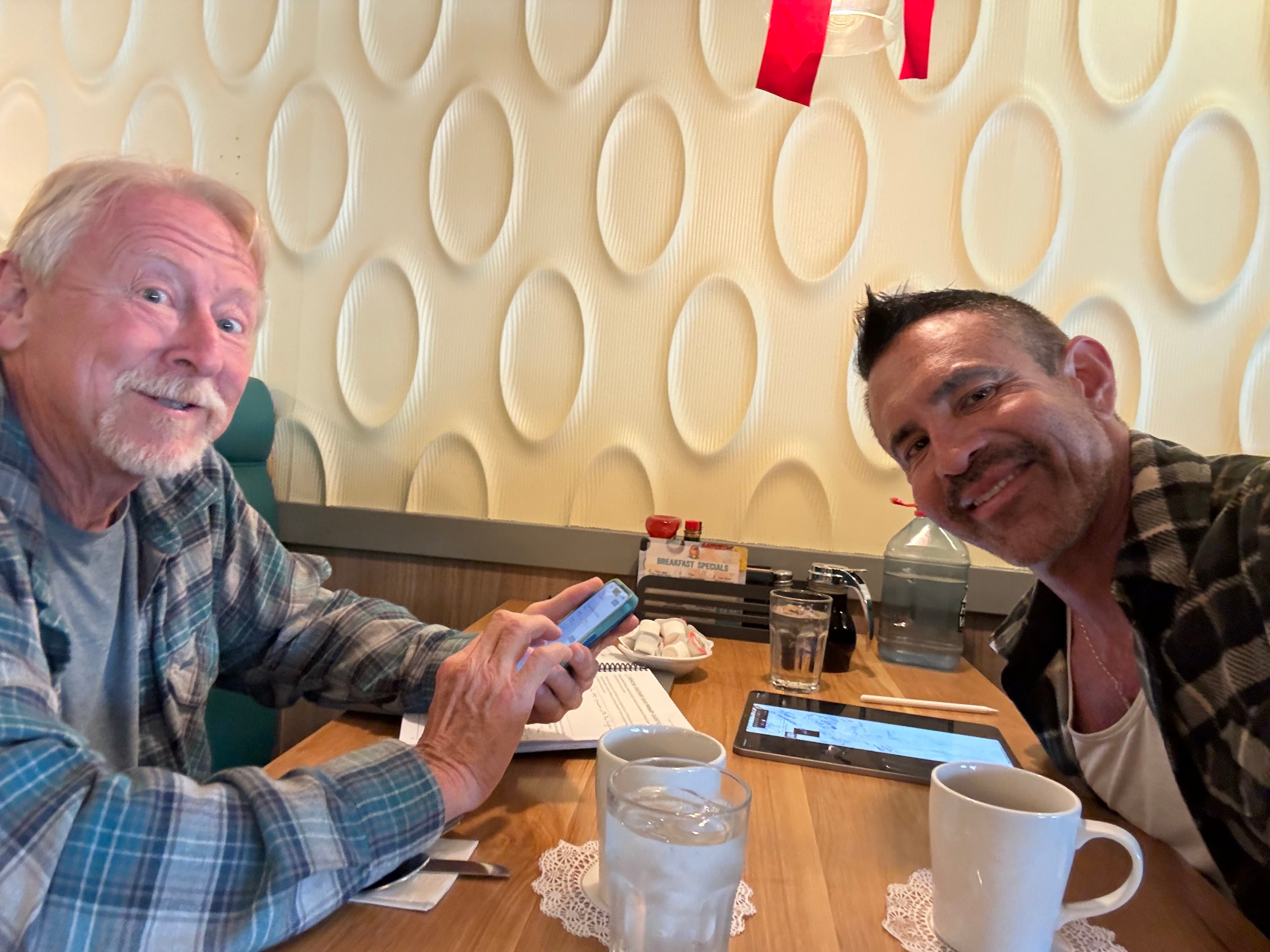
A little over two weeks ago, I published the first letter I had ever written about losing my best friend. I called it “The Jim Novak Creed.” Dr. Jim Novak had died one day before that letter, on Monday, April 20, 2026, at seventy-two, of a heart attack, in the best shape of his life. Please go read that first letter (https://www.jorgecruise.com/p/the-jim-novak-creed) before this one. It is the foundation of everything I am about to write.
This is the second letter. It picks up where the first one left off.
I want to start with the truth about how I felt that first week. I was in shock.
Not the shock of someone losing a sick man. Jim was not sick. This was a man who hiked Mount Soledad with me on Christmas Day, who ate clean, who was strong, who was nineteen years my senior and could still outrun me on the trail. He was, in every sense, the picture of the kind of seventy-two-year-old I want to be at fifty-five.
And he was gone in a single morning, with no warning.
The shock had a second floor I want to name, because it is the part most of us do not say out loud. For a moment, I thought I might be next. When the older man you secretly use as your benchmark for I have time passes suddenly while doing everything right, when he passes at seventy-two, the math in your own head reorganizes itself. If Jim could go, who am I? I am not proud of how self-referential that thought was. But it was there.
Underneath the shock, there was one question I could not stop asking.
Why?
Why this man. Why now. Why, when his work was so clearly not done.
I asked God for an answer for two weeks and did not get one.
This past Monday, I did.
This letter is about what the answer turned out to be.
The turn
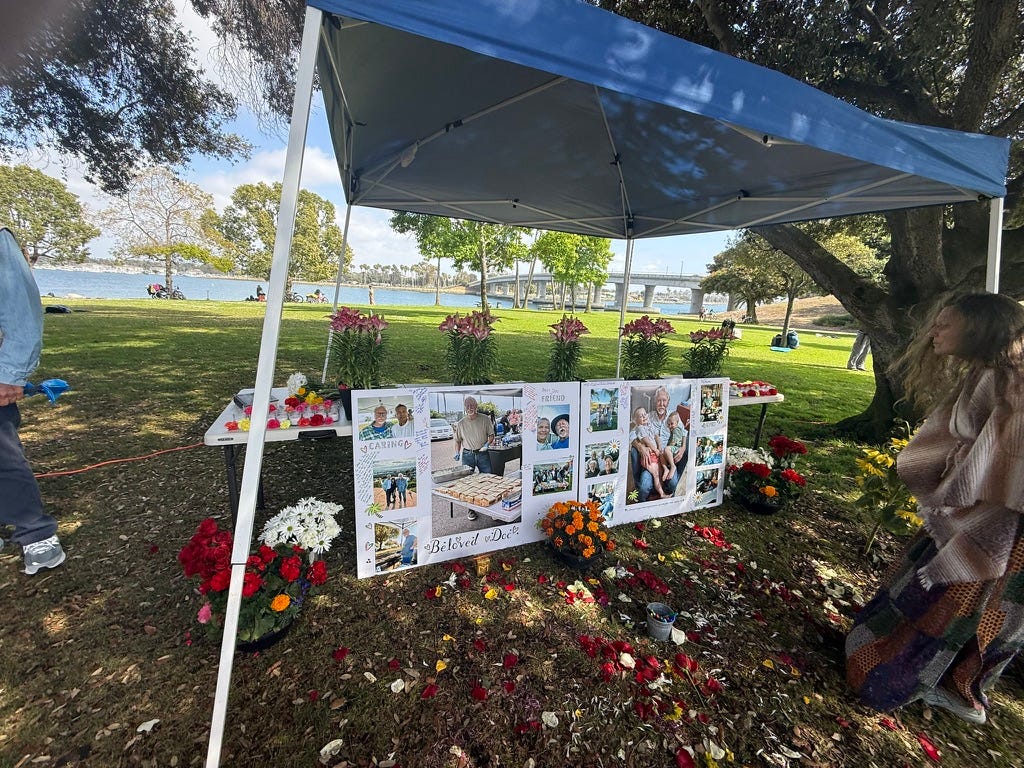
On Thursday, April 30, I drove to Ventura Cove for Jim’s celebration of life with my heart still in pieces.
What happened in those three hours rewrote me.
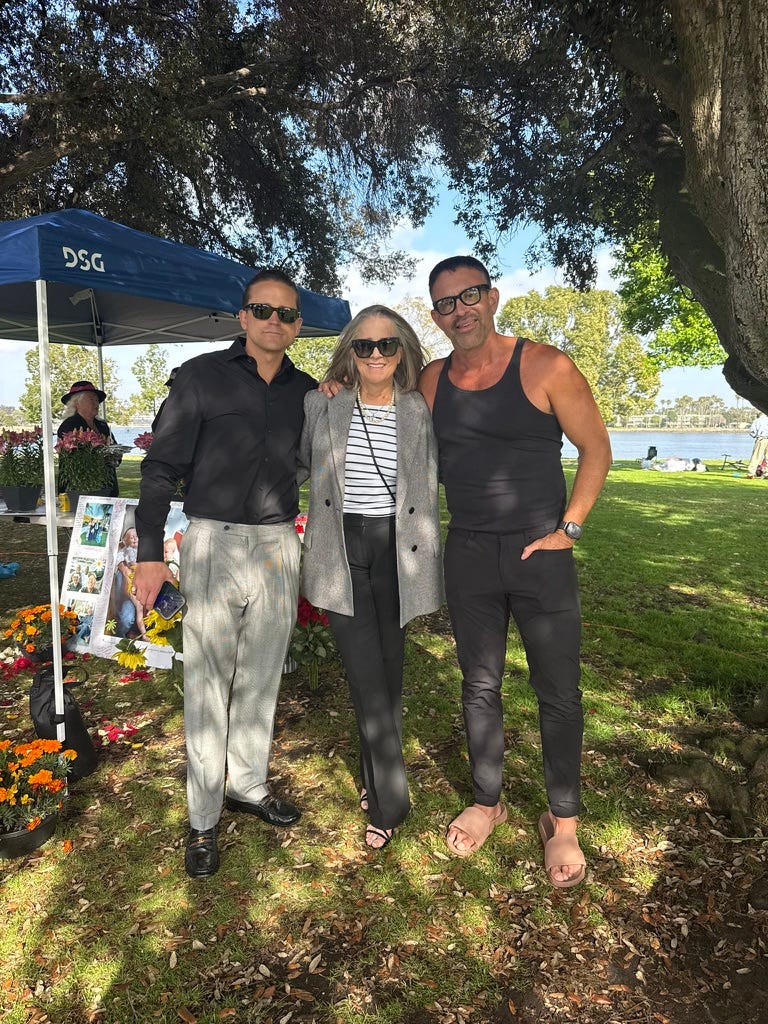
A celebration of life, done right, is not a funeral. A funeral is grief in a black suit. A celebration of life is people doing what the dead would have done if they were still here. Networking. Hugging each other. Eating on the grass. Doing God’s will, as Jim used to say without irony.
People did not come to that lawn to talk about how sad they were. They came to talk about how Jim changed their lives. Three hundred and fifty of them. The stories were specific. The stories were funny. They were full of recipes he gave away, hikes he took people on, treatments he refused to write, treatments he wrote for free. That is how we should remember the people we love in 2026. Not embalmed in sadness, but brought back to life by what they planted in us.
A celebration of life done right is also a prescription pad. The lessons of the dead person get rewritten, in new ink, in new handwriting, onto the lives of the people who showed up.
I walked in carrying shock. I walked out carrying a circle.
I did not arrange a single piece of it. I just showed up empty and let the room work on me.
That is what let go and let God actually means. It is not passive. It is the most active spiritual practice I know. You stop arranging the outcome. You show up. You let the universe do what only the universe can do.
Melinda, the sister the universe sent me
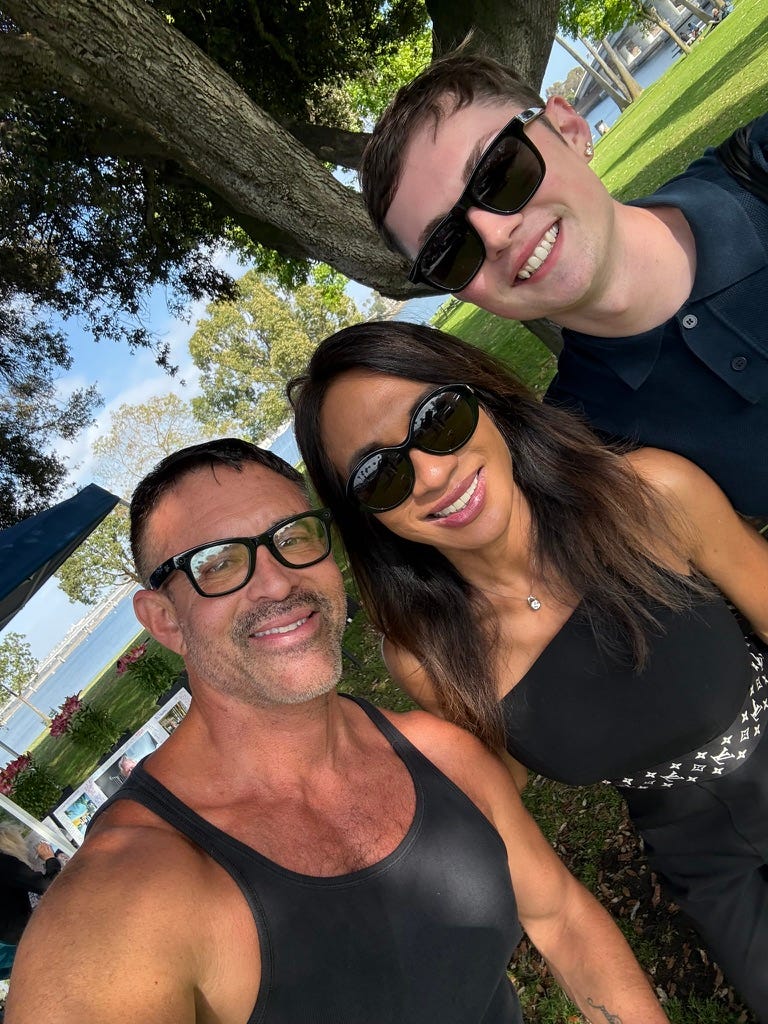
The most important person I met that afternoon was a woman named Dr. Melinda Silva, MD.
Melinda is, at almost sixty-three, one of the most vibrant, light-filled, alive humans I have ever met. She lifts. She trains. She radiates the kind of physical and spiritual force most of us spend midlife trying to remember we are capable of. She is board-certified in family medicine, fellowship-trained in integrative and regenerative medicine, and the author of Aging Gracefully and Strong. Her own patients voted her Compassionate Physician of the Year. She runs two clinics in San Diego: one in Eastlake near the lakes in Chula Vista, and one on Garnet Avenue in Pacific Beach, two blocks from where Jim spent forty years saving lives.
And she was Jim’s mentee. For fifteen years.
When I asked her, in a text earlier this week, whether she would share something for this letter, what she wrote back stopped me in my chair. She said that long before hormone therapy was widely accepted or trendy, Jim was already doing the work, quietly, courageously, with unwavering conviction. She said that fifteen years ago, when she began her own journey into integrative medicine, there were very few mentors to look up to, and that Jim did not just walk that path for her. He illuminated it. She said he revived her faith in medicine at a moment when she had begun to lose hope in the establishment.
And she closed her message with one line that, frankly, made me cry on my couch:
“His legacy lives on in all of us who continue the work he so bravely began.”
That is the woman who, on the lawn at Ventura Cove last Thursday, sat with me for the better part of an hour and, without me asking, offered to become my primary doctor.
Here is why Melinda matters to me, beyond the medicine.
I do not have many close women in my inner circle at this stage of my life. Niki, my stylist and dear friend since 1990, is one of the very few. The odds of forming a deep new friendship at fifty-five are statistically low. Most of us at this age are not adding new people to our inner circle; we are managing the depletion of the inner circle we already had. And then, on the lawn, the universe handed me a Filipina-American woman in her sixties who is going to become my sister.
I can already see the shape of what is coming. She is a sister figure, full stop. The universe knew I needed one. It put one on the lawn.
Raul, the two-for-one with Jim
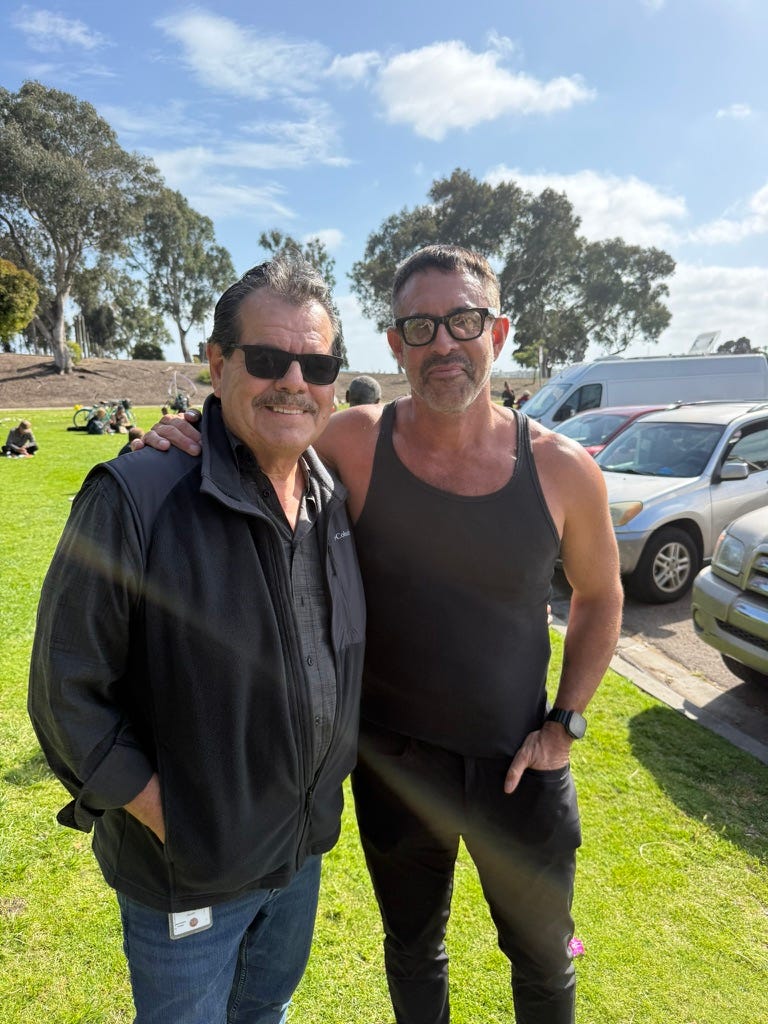
The first person who walked up to me on that lawn was a man named Raul Tellez.
Raul is what I have come to think of as my two-for-one with Jim Novak. He carries Jim’s spirit forward in a way few other people do. He was, for the better part of twenty-five years, one of Jim’s closest friends. He is Latino. I was born in Mexico City. And in the ninety minutes we stood together on the grass at Ventura Cove, this man and I became something I do not have an English word for.
Hermano.
When I asked Raul to share something for this letter, what he sent me yesterday morning was so generous, so detailed, and so revealing of a side of Jim I had never seen, that I am going to let him tell it in his own voice. This is Raul, not me.
He first met Dr. Novak in the early 2000s as a patient, “never imagining that our connection would grow into one of the most meaningful friendships of my life.” From that very first visit, Jim had a rare ability to make you feel like more than just a patient. You felt like family. What began in Jim’s clinic evolved into a genuine, lasting friendship. Raul remembered the moment Jim briefly opened an office in Sherman Heights, an underserved community in San Diego, because “giving back to those in need was always close to his heart.”
They shared a deep curiosity about health and wellness, often exchanging ideas about new approaches and ways to help people heal. Jim, in Raul’s words, was “endlessly curious and open-minded, always searching for better ways to support those in his care.” His motivation was never recognition. “It was simply about helping people feel better, no matter what they were going through.”
Over time, Jim became more than Raul’s doctor. He became their family doctor, caring for Raul’s wife and two daughters for more than two decades. When Raul’s wife became seriously ill, Jim was always there. Day or night. Ready to take the call, offer guidance, and provide comfort during their hardest moments. “That kind of dedication is rare, and it is something I will never forget.”
But the part of Raul’s letter that stopped me in my chair was the part about Mexico.
Jim loved Mexico. Raul introduced him over the years to friends and colleagues there who shared their interests, both in the United States and abroad. A few years ago, Jim invited Raul to join him and a small group on a trip to explore a wellness center called El Grullo, outside of Puerto Vallarta, a place focused on healing and health. Jim was considering purchasing the business and wanted Raul’s honest opinion.
They spent a week there. Raul came home physically renewed (he lost fifteen pounds), but more importantly, he came home with a deeper understanding of the man Jim was. During the stay, Raul learned that the ownership had some complications and shared his concerns with Jim. Jim listened carefully and chose not to move forward. He later thanked Raul. “That spoke volumes about his humility and the value he placed on trust and honesty.”
About two years ago, Jim called Raul with excitement in his voice and asked if Raul would be interested in purchasing land in Mexico, about an hour outside of Puerto Vallarta, in the mountain town of Mascota. Knowing Raul was a Mexican citizen, Jim thought the process would be easier for him, and wanted to share the opportunity so we could be close to one another. Raul gave it serious thought. His family roots are about an hour from there. It was not feasible for him at the time.
But Jim went ahead. He talked about that land constantly: the views, the possibilities, the life he envisioned there. He planned to build a custom home, and he would send Raul renderings of the property; each one was more impressive than the last. But what stood out most, in Raul’s words, “was not the home itself. It was his purpose.”
Jim was not building a vacation house in Mascota. He was building a wellness center for the surrounding community. A place where people in the mountains an hour from Puerto Vallarta, people without a Pacific Beach to walk into on Lamont Street, could come to heal. That was always his driving force, Raul wrote. “His heart was in helping others.”
He kept Raul updated on the progress, always ending their conversations with the same invitation: pack your bags and come visit once everything is complete. It is heartbreaking that Jim did not live to see it finished, or to spend a single afternoon in the place he spoke about with such joy. “That dream, like so many of his efforts, reflected who he was at his core, a man who looked beyond himself and sought ways to uplift others.”
Raul closed his letter with a sentence in Spanish that I want to leave on the page exactly as he wrote it, untranslated, because some things only land in the language they were born in.
“El mundo es menos brillante sin ti. Descansa en paz, mi gran amigo.”
Raul Tellez
We are going to Mexico together. He is helping me reclaim the dual citizenship I have had on paper since birth and never claimed. We will see each other every month. Some friendships take twenty years. Some take a Thursday afternoon on grass.
Anna Claire and Thomas, the divine meeting
The third encounter requires me to take you to a place called Sun Life Organics.
If you do not know about it, here is what you need to know. It is the wellness sanctuary founded by Khalil Rafati, the author of the memoir I Forgot to Die, a man who survived multiple overdoses and homelessness on Skid Row before building, from the ashes of his old life, the most beautiful spiritual community space in California. The original Sun Life is in Malibu. The newer one is in Del Mar. Khalil’s businesses are not restaurants in any conventional sense. They are vortexes of energy: twenty-thousand-, thirty-thousand-, fifty-thousand-dollar mineral specimens, geodes the size of small children, crystals taller than the people standing next to them. You walk in and your nervous system changes.
A few months ago, I went to the Del Mar location alone, on a day I was not feeling well. I had tried In-N-Out. I had tried Tender Greens. Neither one carried the spiritual frequency I was looking for. So I drove to Khalil’s place because I knew the room itself would feed something the food alone could not.
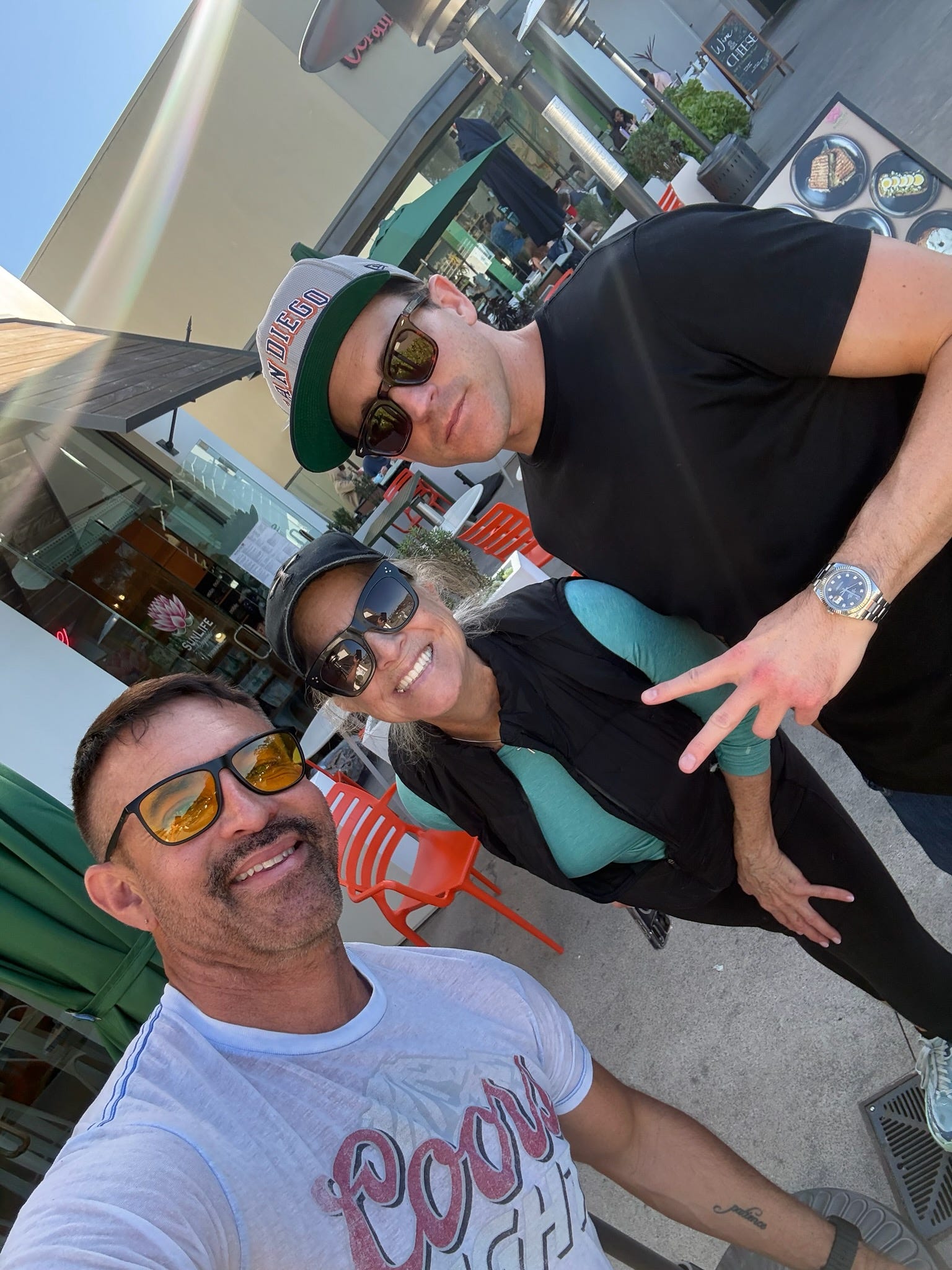
I sat down. And next to me were a beautiful woman and her tall, lean, healthy son. We started talking the way people talk in places with that kind of energy, without the usual armor. I had no idea who they were. They had no idea who I was. We were just three people Khalil had pulled into the same vortex.
Her name is Anna Claire Le Beau. Her son is Thomas.
I would not learn until weeks later, until Jim died, and Anna Claire reached out to me with the kindest text message I had received in months, that she and Thomas were two of Jim Novak’s most profoundly loved patients.
What Anna Claire shared with me earlier this week is the kind of thing every American family with a teenager on multiple psychiatric medications needs to read. I am telling it with her permission and Thomas’s.
Thomas began seeing Jim in his early twenties, after a journey that started when he was fourteen and that, by the time he reached Jim, had taken him through twenty-five different pharmaceuticals across nearly a decade in the Western psychiatric system. By twenty-one he was, in Anna Claire’s word, a legal drug addict, ultimately addicted to Xanax. The addiction was unknown to her for a long time. When they discovered it and pulled him off abruptly, he had a grand mal seizure.
That is when they got him to Jim.
Jim did what Jim did. He pulled Thomas off everything, slowly and safely. He changed his diet to living foods. He got him to give up cigarettes and minimize alcohol. He addressed every input that was stressing his nervous system. And, in the way Jim built relationships with all his patients, he and Thomas bonded. Over healthy eating. Over intermittent fasting. Over exercise.
Thomas became, in his mother’s words, absolutely obsessed. He practices everything Jim taught him today. Eighteen months ago, he walked away from alcohol. He and Anna Claire have talked about going public, speaking together on youth depression, anxiety, and suicidal ideation, with Thomas’s recovery as the spine of the message.
He credits Jim Novak with saving his life.
Anna Claire’s own story she described as “a little more boring.” It is not. In her late fifties she began waking up exhausted, with a brain that was, in her words, muddy and foggy. She is a Broker of Record. Her mind is the asset. Jim ran extensive blood work.
Her mercury level came back at 159.
A mercury level of 5 is considered a serious health issue. Hers was one hundred and fifty-nine. Jim was, in her word, shocked she was not bedridden. He chelated her every Friday morning for about a year and pulled it all out.
He saved her life.
That is who Jim Novak was. That is who we lost on April 20. And that is why the room at Ventura Cove was 350 people deep.
The universe placed Anna Claire and Thomas in front of me at Khalil’s vortex months before Jim died. I had no idea what I was walking into. They had no idea what they were walking into. There are no coincidences. There is only the work of a Higher Power, arranging meetings on a timeline we cannot see.
Brandi, and the man at home
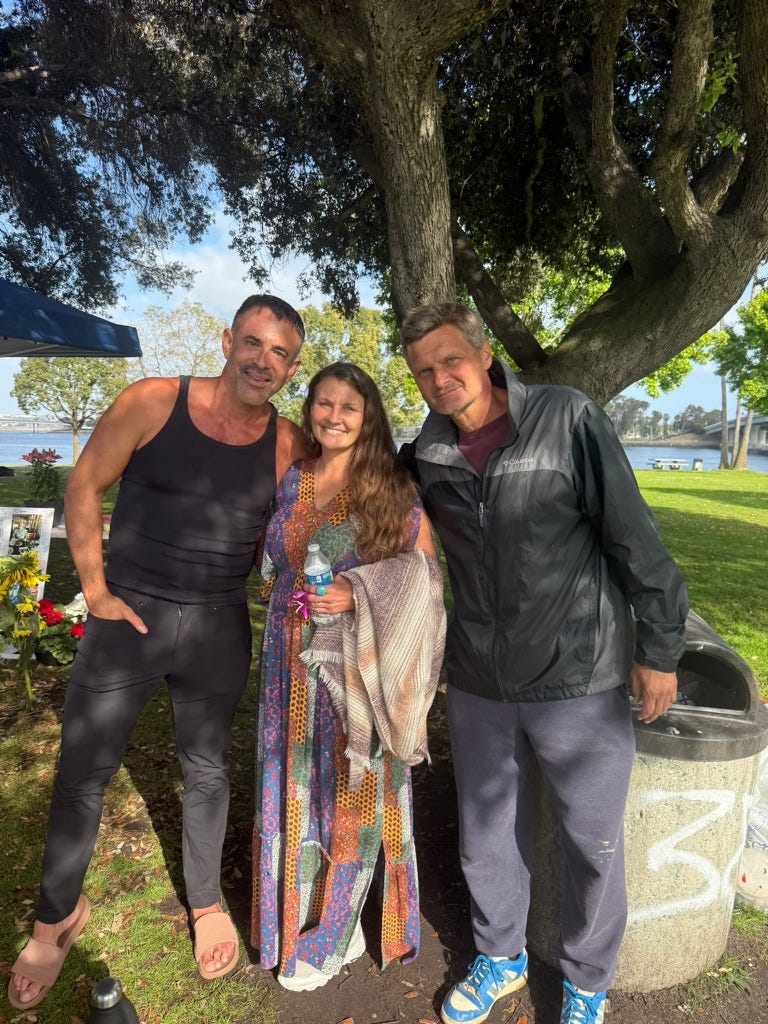
I want to acknowledge two more names briefly. Brandi, the death doula who chose the music for my first ketamine session in 2021, the year I lost my father, my sister, my second marriage, and very nearly my own life. Jim ran those sessions. The last time I saw Brandi before Ventura Cove, she was hanging on by a string. At the celebration she walked up to me radiant. She is a death doula now, helping people pass with peace, the way Jim helped me come back to life.
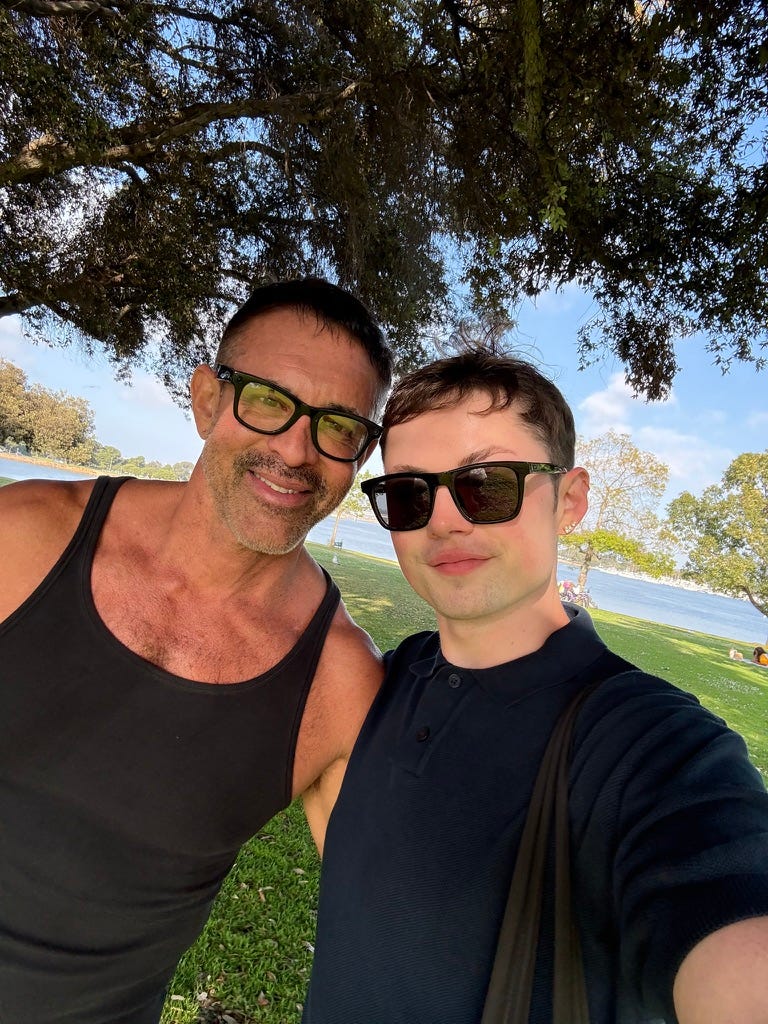
And the man I am so lucky to have had at my side that day. My partner, Wyatt.
Wyatt and I met during the worst stretch of my life, which means he saw, up close, how deeply Jim Novak cared for me before he ever met Jim himself. Over the years that followed, Wyatt and Jim came to know each other well, and Wyatt was there with me on the lawn at Ventura Cove last Thursday, paying his respects.
For someone who has been through two divorces, I never thought I would find love again. I especially never thought I would find love with someone who is, in every measurable way, my equal. That is the part of this story I never let myself plan for.
Wyatt has been the steady center of my life for years now. When things have gotten difficult, and they have, he has carried his weight without ever making it a transaction. Earlier this year, when there was a gap in income while I was starting new ventures, Wyatt was there to help close it. I have never been with anyone who has shown up for me the way he has. He has the gift I do not have: he can be alone and be at peace. He can sit in a house for a weekend and emerge restored. I cannot. I am working on building something closer to that in myself. Less dependence on any single person, including him. More inner ballast.
What has surprised me most about loving Wyatt is the way our love has grown because we are equals. We mirror each other. When one of us needs a correction to become our best self, the other one says it, gently, but plainly. That is what equals do. The marriages I had before were not built that way. This one is.
A relationship cannot carry the full weight of one person’s social hunger. Wyatt is one chair, and one human cannot be five chairs. No one can. Melinda, Raul, Anna Claire, Thomas, Brandi, Niki, JJ, my AA rooms, Sigma Chi, my kids: these are the chairs that take the load off the love at home and let it be what love is supposed to be. A center, not a stand-in for the entire community.
Thank you, Wyatt. I love you.
The teaching: we are made for each other
Here is the deepest thing I have learned from this loss.
Humans are social beings by design. Not by preference. By design. Our nervous systems were built, over hundreds of thousands of years, to function inside a tribe. Hierarchy, belonging, family, ritual, the chosen room: these are not luxuries. They are the operating environment our biology was written for. Take a human out of community and the system starts to fail in measurable ways. Cortisol rises. Inflammation rises. Sleep collapses. Mood collapses.
A small percentage of humans genuinely thrive in long stretches of solitude. Maybe ten or fifteen percent of us. I am not one of them. The vast majority of us are not. The wellness culture of the last decade has, in my view, sold a lie to midlife adults: the lie that you should be able to do this alone. You should not. You were not built to.
The work is not “learn to need no one.” The work is “build a circle wide enough that the loss of any one person does not break you.”
That is what Ventura Cove handed me. A wider circle.
The 350 people on that lawn were Jim’s circle. They are now, by inheritance, mine. What I felt standing among them, what I am still feeling, six days later, is that this circle is not going away. We share too much. The same vision. The same focus. The same quiet conviction that the right way to live is the way Jim lived. Quietly. Without performance. With patience. With the patient sitting in front of you treated as the most important person in the world for the next forty-five minutes, and then with the next patient treated the same way.
That is the community he built. And it is now ours to carry.
The drive home
I want to tell you what happened on Monday morning’s drive home from the gym, because if you are wondering whether the universe ever bothers to confirm the decisions you make, this is my answer.
I went to the gym Monday morning thinking I would come home and finish writing this letter. Three drafts. Three rewrites. I could not hear Jim’s voice. So I went to the gym. And on the drive home, three things happened in fifteen minutes that I now believe were not coincidence.
Sign one. The coffee shop. I drove past a place where Jim and I had once sat together. He had ordered decaf. I made fun of him. He looked at me with that quiet half-smile of his and said, “Jorge, if you cannot sleep, and you cannot sleep, switch to decaf. A regular cup is about ninety-five milligrams of caffeine. A decaf cup is two to seven. You will lose almost nothing in flavor and you will get your sleep back.” USDA figures confirm those numbers. A 93-percent reduction with almost no taste penalty. He was right ten years ago. I am finally listening.
Sign two. The butcher shop. A few blocks later I drove past the place where Jim used to take me. He loved that place. He would walk me up to the counter and point out the heart, the brain, the liver, “the original multivitamin,” he called organ meats. He believed in this so deeply that he was, in his last years, eating a near-carnivore diet built around grass-fed protein and time-restricted eating. That is how Jim ate.
Sign three. My right pinky pulsed. At the next light, the same finger that has been quietly inflamed for months, the same finger, the same joint, the same inflammation pattern that ran up my mother Gloria Cansino’s hands and feet and arms toward the end of her life, began to throb. Gloria self-medicated with ibuprofen and Tylenol for years. By the time we understood what it was doing to her kidneys, on February 5, 1998, she was gone. She was sixty-four. I am fifty-five. I do not want to go where she went. I want to go where my grandmother went. She lived to one hundred and three.
God, give me a sign. He gave me three. In fifteen minutes.
The decision: jump-start, not crutch
I want to use the rest of this section to make a commitment to you, and to Jim, on the public record.
For the last several weeks, I have been over-relying on a prescription stimulant. I have been taking Adderall to push through deadlines. The medication works. It also wrecks my sleep. And I have noticed something I want to be honest about: in the weeks I have been taking it most heavily, I have not been at my best. Less patient. Less present. Less Jim.
I am not telling anyone reading this to stop their medication. That is between you and your doctor. None of this is medical advice. I have enormous respect for Dr. Daniel Amen and the doctors who prescribe stimulants responsibly. For people with severe ADHD, the medication can be life-changing.
But I have been forgetting the lesson Jim taught me about every medication, going back twenty-three years.
Use it episodically. Use the lowest dose that works. Use it for the shortest window possible. Find a natural alternative wherever one exists.
Jump-start, not crutch.
That is the four-word ethos that runs through everything Jim ever prescribed me. The same lesson he taught Thomas about Xanax. The same lesson he taught me on Mount Soledad about GLP-1s. The same lesson he would have wanted me to apply to Adderall this spring, while I was using it like a crutch and telling myself it was a jump-start.
So here is my commitment, which I want to make in writing, where I cannot take it back.
I am not removing Adderall from my life. I am not throwing my prescription away. I am not making a binary, dramatic vow. I am, instead, committing to the jump-start-not-crutch ethos for the rest of my life: for Adderall, for caffeine, for any medication a doctor and I decide is worth using.
And I am committing to the conversation Jim would want me to have with my doctor, and that I want every reader of this Substack to consider having with theirs:
“Doctor, am I using this as a jump-start, or as a crutch? What’s the off-ramp? What’s something natural I can do that mimics what this is doing for me, so I can use the medication for the shortest window I actually need, and walk on my own again?”
For me, the off-ramp is the one Jim told me about ten years ago. The gym. And specifically, the part of the gym I have been avoiding for almost three months. Cardio. Walking. Hiking. Sustained heart-rate elevation. The 2021 systematic review of exercise and ADHD confirmed that physical activity hits the same catecholaminergic pathways, dopamine and norepinephrine, that stimulant medications hit. Jim told me this in 2015. Move first. Pill last.
So I am not removing anything. I am adding cardio back. That is my commitment to Jim. Not subtraction, addition. Move more than I medicate.
It is also why, in the Novak Reset I am about to share with you, the first rule is Move. Jim’s number one was always walking. Mine is going to be too.
Gloria. Jim. Two bookends.
My mother died on February 5, 1998. I was twenty-seven. That is the loss that built my career. For twenty-eight years I have been writing books and building businesses on the unstated foundation that my mother did not have to die, that she lost her life because she did not have the right information at the right time, and that my work would put the right information into the hands of as many people as possible.
Now Jim is gone. And I think this loss is going to do for the next chapter of my work what Gloria’s loss did for the first.
Two catalytic bookends. Twenty-eight years apart.
Gloria gave me the first chapter. Jim is giving me this one. That is what mentors do, even after they are gone.
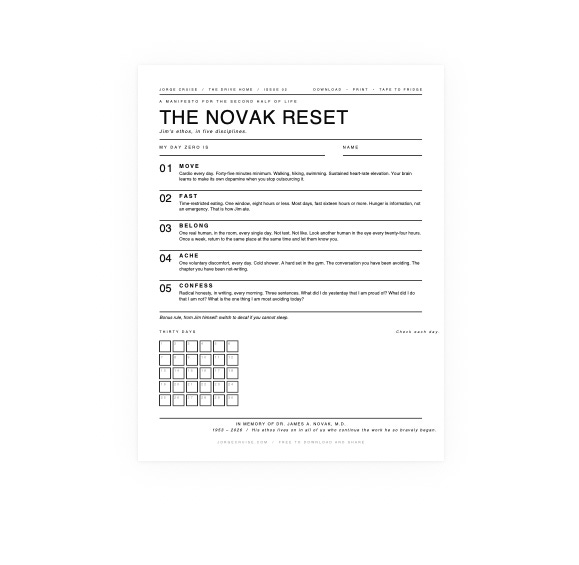
The Novak Reset: Jim’s ethos for the second half of life
Here are the five rules I am living by, starting Friday, May 1. I am calling it the Novak Reset, because it is Jim’s ethos distilled into five disciplines I am reminding myself of every morning before my feet hit the floor.
1. Move every day. Forty-five minutes minimum. Walking, hiking, swimming. Sustained heart-rate elevation. Your brain learns to make its own dopamine when you stop outsourcing it.
2. Time-restricted eating. One window, eight hours or less. Most days, fast 16+ hours. Hunger is information, not an emergency. Your body does not need food as often as the food industry has trained you to believe. That is how Jim ate.
3. One real human, in the room, every single day. Not text. Not like. Look another human in the eye every twenty-four hours. And once a week, return to the same place at the same time, your meeting, your church, your dinner, and let them know you.
4. One voluntary discomfort, every day. Cold shower. A hard set in the gym. The conversation you have been avoiding. The chapter you have been not-writing.
5. Radical honesty, in writing, every morning. Three sentences. What did I do yesterday that I am proud of? What did I do that I am not? What is the one thing I am most avoiding today?
Bonus rule, from Jim himself: switch to decaf if you cannot sleep.
I have built a one-page Novak Reset card in honor of him: a printable, beautifully designed reminder of these five rules, with a 30-day check-box grid and a small dedication to Jim at the bottom. It is free. Download it here. Print it. Tape it to your fridge. Share it with as many friends as you want. No email signup, no paywall, nothing to buy. That is what I am doing for the rest of this year. Hopefully longer.
Pick It Up: a song for Jim
I want to share one more thing before I get to the closing of this letter. It is the most personal thing I am putting in writing today.
For years, I have been teaching my coaching clients on Monday nights at five p.m. Pacific that one of the most powerful things you can do, when something painful happens in your life, is to take the pain and turn it into an anthem. Lyrics. Music. A song you can play on the days you forget what the lesson was. Pain into power. That is the practice. I cannot sing for anything. I want to be the first to make fun of myself for it. But I can write. And we live in a moment where the AI tools available to all of us mean you do not need a record deal to put your grief into a song. You just need the words.
So on Monday morning, after the drive home, after the three signs, after the pinky pulsed, I sat down and wrote the lyrics for a song called “Pick It Up.”
It is a tribute to Jim. It is universal. The lyrics never name him; they just speak to anyone who has lost a mentor, a parent, a friend, and is standing at the edge of a decision they have been putting off. The chorus is the line I want every person in midlife to chant the next time they are tempted to wait one more day: Hoy, hoy, hoy, pick it up, pick it up. That is what Jim was telling all of us, every day of his life, with the way he showed up for his patients. Today. Today. Pick it up.
Whether you knew Jim or not, this song is for anyone who has been waiting for tomorrow to do the thing they already know they have to do. It has helped me already, just writing the words. It might help you too.
Click here to listen to “Pick It Up” on Suno. (https://suno.com/song/ff3a9beb-f7f7-4950-85d6-5935e7eb83b7)
If it moves you, please share it. The link is free, the song is free.
If you have your own painful experience and you want to try the practice, write the lyrics yourself, even if you have never written before. Do it. Lyrics, for an experience this big, are easier than you think. You are not writing a book. You are writing five verses about something true. That is enough.
The manifesto
I am still here.
I lost my mother at twenty-seven. I lost my best friend at fifty-five. The universe could have broken me a dozen times over and did not.
I am choosing presence. I am choosing community. I am choosing to use this loss the way Jim would want me to use it: as fuel, not anchor. I am choosing to be the kind of fifty-five-year-old who is building toward the seventy-two-year-old Jim was, instead of the kind of fifty-five-year-old mourning the loss of him.
This is my manifesto. Jim is gone. His ethos is in my pocket. The torch is mine.
If you have lost someone, last year, last decade, thirty years ago, go to the next celebration of life you are invited to. Stay for the second hour, not the first. Sit on the grass. Hug the people you have not hugged in fifteen years. Let yourself be ambushed by grace.
And then pick up the torch.
Carry it well.
— Jorge
This Substack is not medical advice. Talk to your doctor about any medication changes.