

The new science that controls hunger
Two hungers, one solution: mineral balance for the body, dopamine balance for the mind.
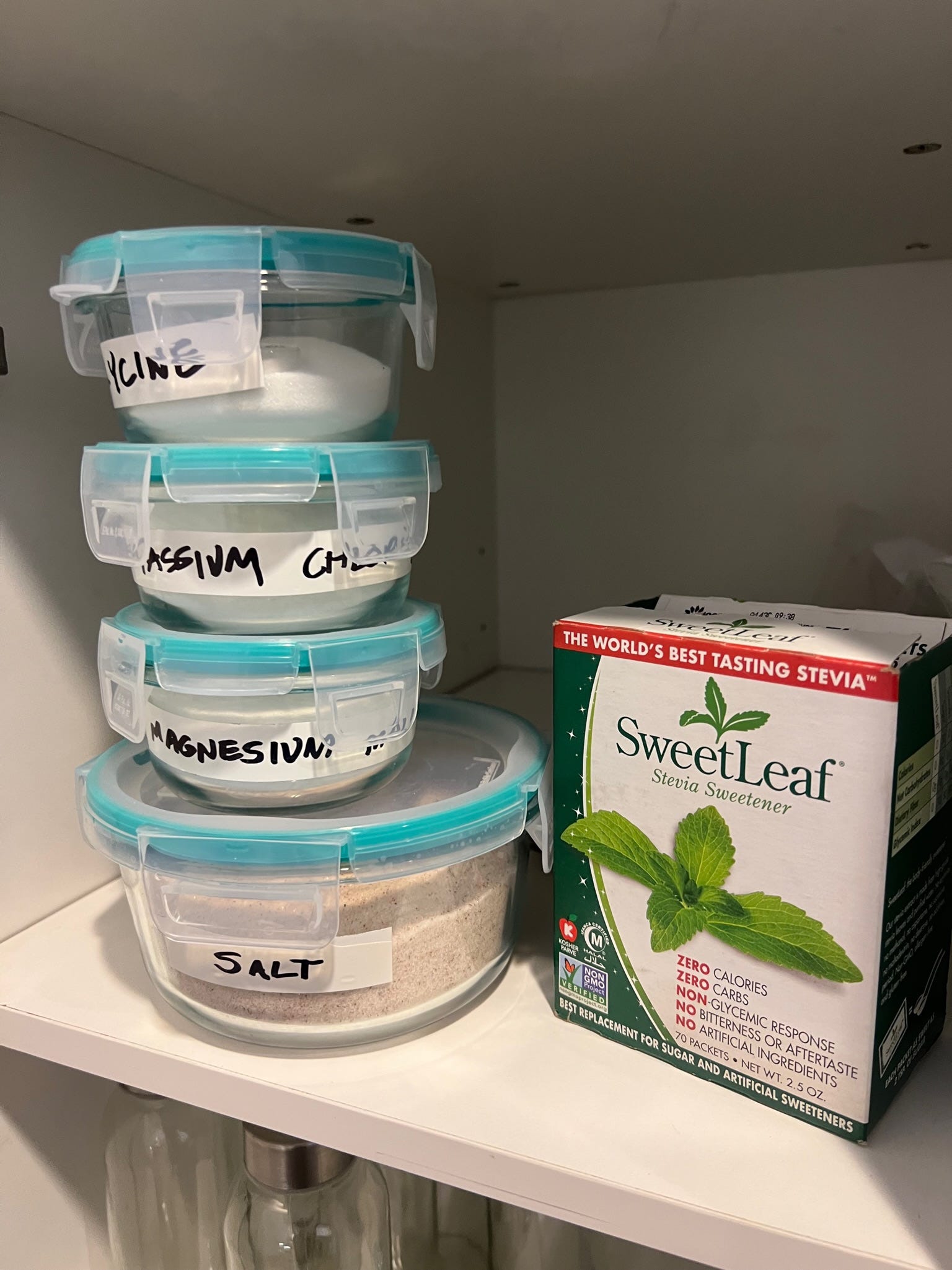
If you’re in midlife and still negotiating with the pantry, here’s the truth I’ve learned writing 39 books: there are two kinds of hunger. Physical hunger is cellular—an electrolyte signal asking for sodium, potassium, and magnesium. When these are low, the brain misfires “eat sugar now,” insulin control wobbles, and willpower gets blamed for what is, in fact, chemistry. The evidence is strong: low sodium intake tracks with higher added sugar consumption; sodium restriction worsens insulin resistance and primes appetite hormones; raising potassium predicts meaningful drops in BMI; magnesium steadies glucose and stimulates CCK, the fullness cue. Restore minerals and the nervous system quiets. That’s why I start clients with Zero Hunger Water: simple, precise, effective.
Emotional hunger is different. It’s the theater of dopamine—our reward currency—shaped by modern, hyper-palatable cues. Stanford psychiatrist Dr. Anna Lembke (author of Dopamine Nation) shows how repeated hits—especially sugar—sensitize the “wanting” circuit, leaving us restless when we’re not nibbling. Her interviews and lectures outline the fix: build friction around instant rewards, pursue effortful pleasures, and give the brain enough “clean wins” to reset the pleasure–pain balance. In practice, that means structuring small victories and connection so food isn’t the only reward on stage.
Click above for my free “Cure Midlife Belly Fat” report, or Start Now to work with me live Monday nights at 5 PM PT.
First 100 members: code founder = 80% off.
Need hardship help? code hardship = 96% off.
Electrolyte and Dopamine Science (ranked 1–9; sodium first, then potassium/magnesium. Dopamine 10)
NHANES (n=38,722): lower sodium intake is linked to higher added sugar intake, implying low‑salt diets can drive compensatory sweet cravings. https://pubmed.ncbi.nlm.nih.gov/32762131/#:~:text=was%2043,the%20associated%20high%20sugar%20intake
Systematic review of 23 human trials: sodium restriction worsens insulin resistance and raises counter‑regulatory hormones, a metabolic state that increases appetite. https://journalofmetabolichealth.org/index.php/jmh/article/view/78/242
Comprehensive review: sodium deficiency powerfully activates salt appetite and rewires reward circuits; repletion normalizes hedonic tone—mechanism for “false hunger.” https://pmc.ncbi.nlm.nih.gov/articles/PMC4433288/#:~:text=PMC%20pmc,82%2C%20118
Controlled rat study: adding NaCl cut food intake by ~10–25% and reduced body‑fat gain—evidence that sodium status can directly suppress feeding. https://pubmed.ncbi.nlm.nih.gov/1252395/#:~:text=containing%2013%20g%20NaCl/kg,%20or,water%20had%20a
Independent institutional repository of the NHANES analysis confirming low sodium ↔ higher sugar intake (secondary source for #1’s finding). https://touroscholar.touro.edu/nymc_fac_pubs/2785/#:~:text=51.2,the%20associated%20high%20sugar%20intake
One‑year program in metabolic syndrome: increasing dietary potassium was the strongest predictor of BMI reduction (~45% of variance), supporting potassium’s satiety/weight‑control role. https://pmc.ncbi.nlm.nih.gov/articles/PMC6627830/#:~:text=regression%20analysis%20revealed%20that%2045,239)%20and
Meta‑analysis of 18 RCTs: oral magnesium improves fasting glucose and insulin sensitivity in at‑risk groups—blunting crash‑and‑crave cycles that fuel appetite. https://pubmed.ncbi.nlm.nih.gov/27530471/#:~:text=,sensitivity%20parameters
Review: magnesium stimulates cholecystokinin (CCK) release; across studies, it suppresses hunger, lowers intake, and reduces body weight (magnesium glycinate preferred for bioavailability). https://www.mattioli1885journals.com/index.php/progressinnutrition/article/view/9081#:~:text=Aim:%20Magnesium%20has%20many%20important,influence%20of%20cholecystokinin%20on%20hunger/satiety
Alternate anchor to #1 (same NHANES cohort) again showing low sodium associates with higher sugar consumption—reaffirming the sodium–sweet craving connection. https://pubmed.ncbi.nlm.nih.gov/32762131/#:~:text=showed%20that%20among%2038%20722,health%20may%20be%20explained%20at
Dopamine Nation (overview and author site). https://www.annalembke.com/ ; Amazon listing: https://www.amazon.com/Dopamine-Nation-Finding-Balance-Indulgence/dp/152474672X