

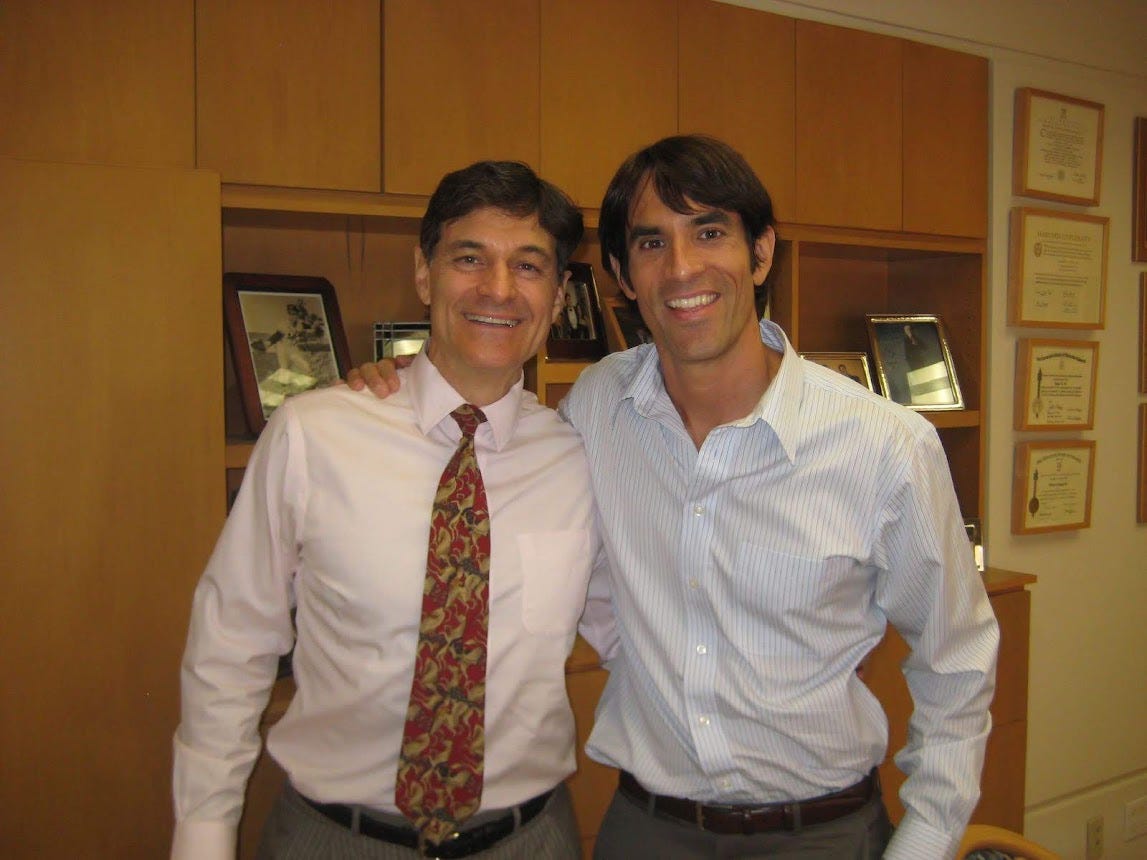
The context: this was July 16th, 2008. Dr. Oz had been appearing with Oprah for years, bringing medical information to a mainstream audience in a way that no doctor had quite managed before. He had not yet launched his own talk show — that would come in 2009. I had known him through my own work with Oprah, who had me on her show and featured me in The Oprah Magazine. We were both, at that point, two people who had found their way into the same orbit through the same gravitational pull: a belief that ordinary people deserved the same quality of health information that was available in academic medical centers.
I had a camera, a small Canon, and a question about belly fat. I wanted him to explain, in his words, exactly why belly fat was dangerous — in the way only a cardiac surgeon who had held a human liver in his hands could explain it. What came out of that conversation is something I have been thinking about ever since, and something that now sits at the center of Step Two of my Longevity Map.
What he taught me about visceral fat — and why it is not like any other fat
Dr. Oz opened with something that stopped me cold. He described a type of fat he had famously brought onto Oprah’s show: omental fat. The omentum is a layer of fatty tissue that sits beneath the muscles of your abdomen, wrapped around your internal organs. You cannot pinch it. You cannot see it in a mirror. You can carry an enormous quantity of it and look, from the outside, like someone who is perhaps just a little soft around the middle.
But unlike the fat on your arms, your thighs, or your hips — which he dismissed, almost fondly, as costing you “a couple of days” — visceral fat is metabolically dangerous in a way that is categorically different.
“That fat is way inside of you, under the muscles of your belly. Those of you who worry about your fat thighs — that’ll cost you a couple of days. But that’s not what a doctor worries about. — Dr. Mehmet Oz, Columbia University, 2008”
Here is the biology he laid out, and it has held up perfectly almost 20 years since: visceral fat is positioned directly adjacent to the portal vein, the large vessel that carries blood from the digestive organs to the liver. In our ancestral past, this placement was a feature, not a bug. When famine struck — and famine struck often — the body could rapidly mobilize that visceral fat, send it through the portal vein to the liver, and convert it to fuel. Visceral fat was the body’s emergency reserve, sitting right next to the expressway that led to the organs that needed it most.
The problem, as Dr. Oz described it with a wry precision I have never forgotten, is that we solved the famine problem but kept accumulating the fat. You can get a carton of milk out of the fridge in thirty seconds now, he said. Our ancestors spent all day hunting. We have the storage system of people who needed reserves, living in a world with no shortage at all.
And so the visceral fat accumulates. Because it sits on that portal vein expressway, everything it secretes — the inflammatory chemicals, the adipokines, the toxic signals — goes straight to the liver. He described three consequences that together constitute metabolic syndrome: the liver, poisoned by those signals, begins producing bad cholesterol, creating the conditions for heart disease. The liver, irritated and overwhelmed, stops responding to insulin properly, leading to type 2 diabetes even in people with normal insulin levels. And the physical mass of the fat itself, pressing against the kidneys, causes them to misread the body’s fluid pressure signals and drive blood pressure up. High cholesterol. High blood sugar. High blood pressure. The three-headed monster of metabolic syndrome, all traceable back to that one fat depot sitting beneath your navel.
“Belly fat gives you high blood pressure, high blood sugar, and high blood cholesterol.” And then he added the number I have never forgotten: a lot of belly fat strips, on average, more than fifteen years from your life.
The tape measure moment — and the formula everyone needs to know
This is the part of the video I want you to watch most carefully, because it is where Dr. Oz delivers something that I believe is one of the most practical and underused pieces of health guidance available to the general public.
He does not ask for BMI. He does not ask for weight. He pulls out a tape measure.
Here is the formula he gave me, and I am going to write it out clearly because it deserves to be written clearly. Your waist circumference should be no more than one half of your height. That is it. That is the number. If you are six feet tall — seventy-two inches — your waist should be no more than thirty-six inches. If you are five feet four — sixty-four inches — your waist should be no more than thirty-two inches. This formula works for children and adults alike, for men and for women, for every body type. It requires nothing but a tape measure and five seconds of your time.
For women: thirty-two and a half inches or less. For men: thirty-seven inches or less. But the formula — waist equals half your height — is the more precise and personal version.
I was thirty-seven years old and measuring twenty-nine and a half inches in that video. Dr. Oz declared me safe. He made me suck in — but safe.
Why this video is actually about time-restricted eating — even though neither of us called it that
There is a passage in this conversation that, when I listen to it now, sounds almost prophetic. Dr. Oz explained why our ancestors’ visceral fat was so responsive — why it could be mobilized so quickly when famine arrived. The answer was timing. During the periods of not eating — the famine periods, the hunting days, the long stretches between meals — the body preferentially drew from visceral fat because of its direct access to the portal vein. It was the most accessible store, sitting right next to the highway that led to the liver.
What he was describing, without using the term, was exactly what researchers have since confirmed through randomized controlled trials. In 2022, a landmark study published in Cell Reports Medicine by Mingqian He and colleagues tested an eight-hour eating window against a low-carbohydrate diet in 169 adults with metabolic syndrome. The TRE group reduced their visceral fat area by thirteen square centimeters. The low-carb group actually gained visceral fat. The mechanism is precisely what Dr. Oz described in that hallway in 2008: when insulin drops during the fasting window, the body turns first to the fat depot with the easiest access to the portal vein. Your belly goes first.
He called it “famine time.” We now call it time-restricted eating, or intermittent fasting. The biology is identical. The science has only gotten stronger since that July afternoon at Columbia.
Where Zero Hunger Water fits into this picture
The reason most people cannot sustain time-restricted eating is not lack of discipline. It is mineral deficiency. When insulin drops during the fasting window, the kidneys excrete sodium at an accelerated rate — and that sodium loss drags potassium and magnesium with it. The body, depleted of those three minerals, fires a hunger signal that is neurologically indistinguishable from genuine caloric need. Research by Morris, Na, and Johnson, published in Physiology & Behavior in 2008 — the same year as this video — showed that sodium deprivation causes the sugar-sensitive neurons in the brain’s taste-processing center to become up to ten times more reactive. The hunger is real. The calories are not needed. The mineral is.
Zero Hunger Water — sodium, potassium, and magnesium, zero calories, no GLP-1 required — is the solution to that specific problem. It restores the mineral balance that makes the fasting window bearable, and in doing so, allows the mechanism Dr. Oz described in 2008 to actually work: your body enters the fat-burning state, it draws from the visceral fat sitting on the portal vein highway, and your belly goes first.
This is not a new idea. Dr. Oz was teaching the biology of it before most people had heard the phrase intermittent fasting. I am just finally building the product that makes it effortless.
What I want you to do right now
First, watch the video. It is just under six minutes.
Second, get a tape measure. Measure your waist at the belly button, over the hips. Take the number seriously. This is not about how you look. It is about your liver, your insulin response, your blood pressure, and the fifteen or more years that excessive visceral fat will steal from you if you let it.
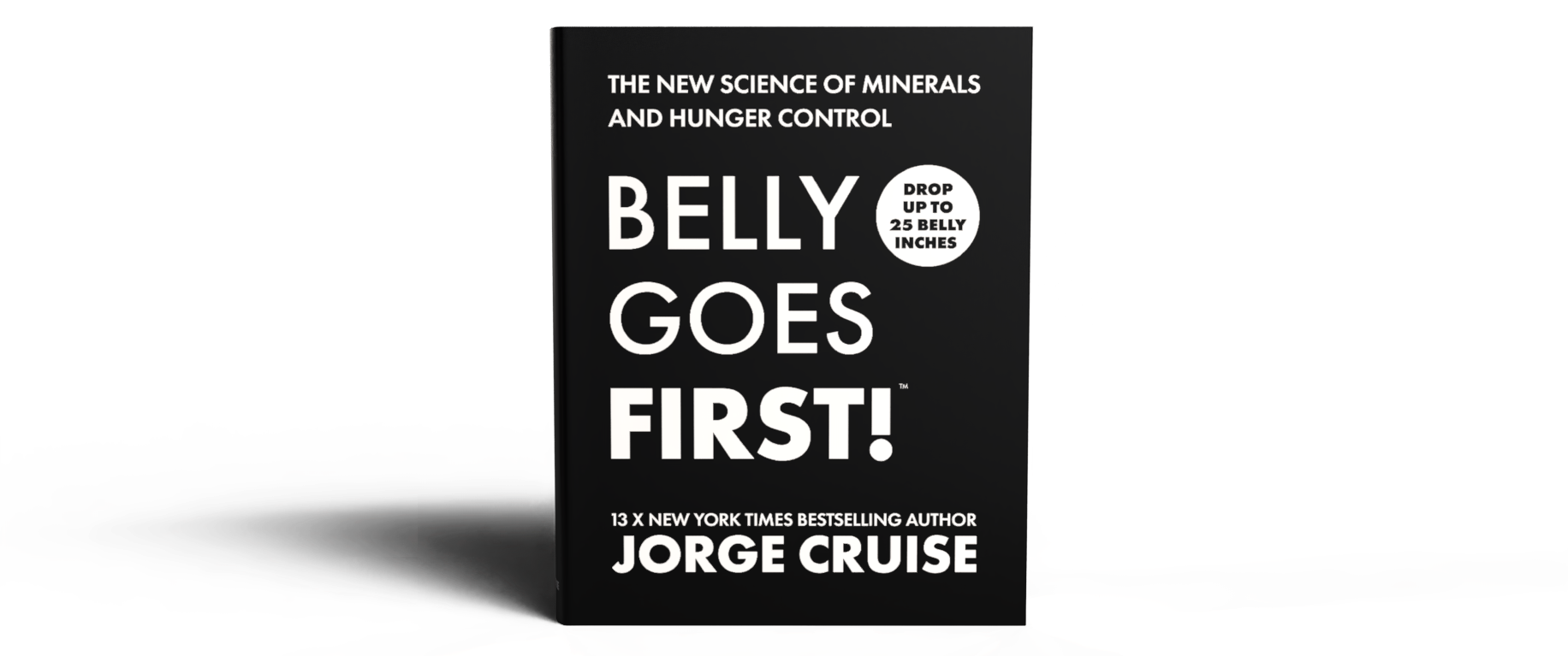
Third, if your number is higher than half your height — or for women higher than thirty-two and a half, for men higher than thirty-seven — download my free Belly Goes First guidebook. It has a nineteen-day challenge with a built-in tracker for your waist circumference measurements at days one, seven, fourteen, and nineteen. It is free. It is designed for both men and women. And it is the entry point to the Longevity Map I have been building for thirty years.
Fourth, if you want to do this with me in real time — join me on Monday evenings at five o’clock Pacific for our live coaching session. That is an invitation from someone who is in it alongside you.
“Your waistline is your lifeline. It was on Jack LaLanne’s belt buckle decades before Dr. Oz confirmed it at Columbia. It is still true today. Go measure.”


